Waking up at Acorn Camping and Caravan site meant that we were in prime location for a coastal stroll. Following the Vale of Glamorgan’s “Vale Trail” suggestions meant an early-ish drive to Nash Point.
Ever the ones to buck a trend, we headed anti-clockwise along route 2 to Nash Point Lighthouse. Nash Point Lighthouse is an iconic 19th century, grade 2 listed, historic building. Built after the catastrophic demise of “The Frolic” in 1831, it is now a major part of Welsh social and maritime history. It was the last manned lighthouse in Wales, being de-manned in August 1998, just a month, or so, before the last manned lighthouse in the U.K. (North Foreland in Kent) was switched over to automatic operation. It is now a wedding venue and tourist attraction, open to the public between March and October.


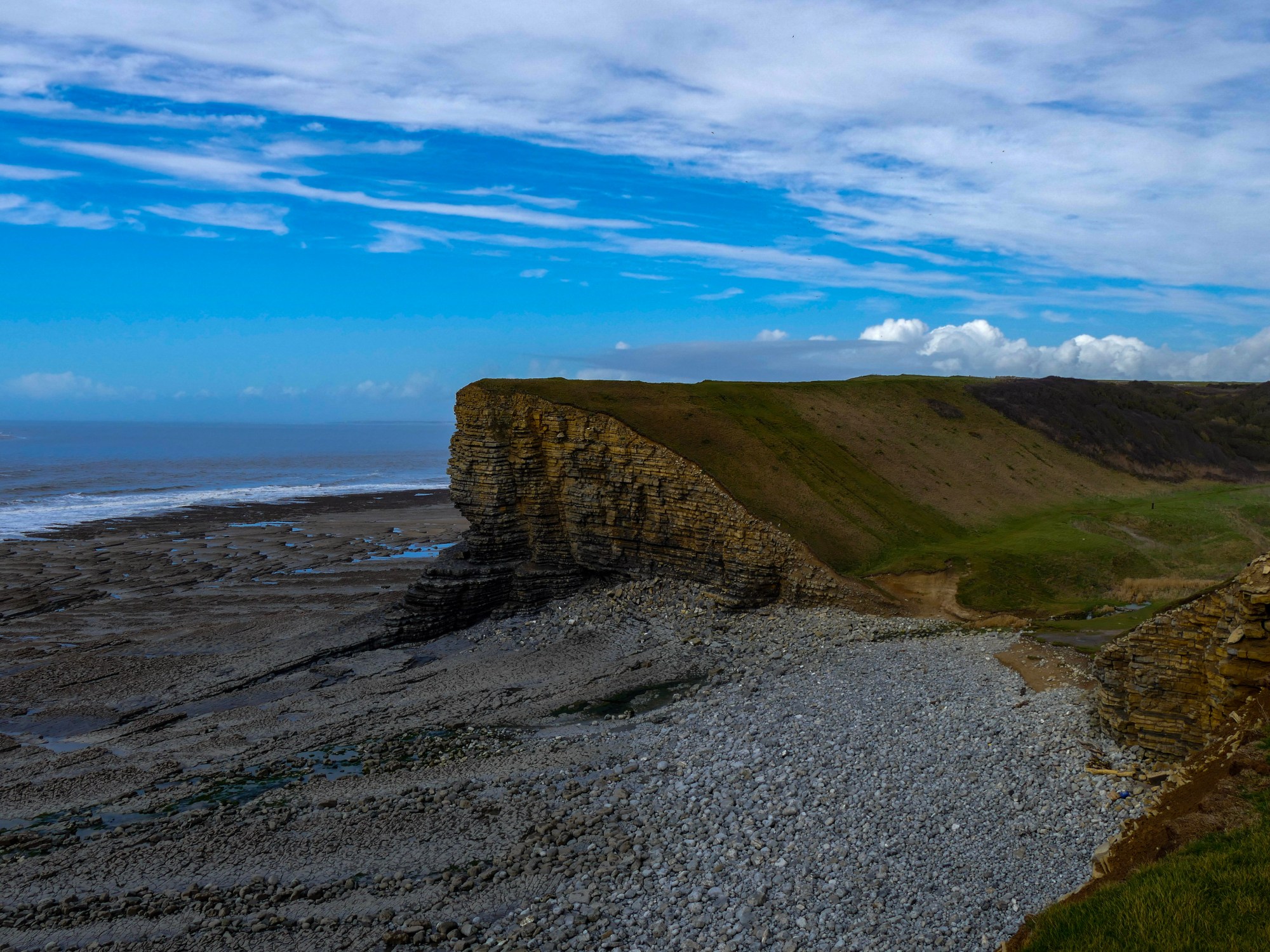
The footpath followed the coastline for the first part, along a well-maintained (albeit very muddy) path. The views of the craggy cliffs were spectacular with clear striations visible within the rock. There were also incredible rock formations on the beach itself – undoubtedly the reason for two lighthouses and a foghorn being installed at Nash Point. Wandering through fields and woodland, we eventually arrived at the coastal side of the Atlantic College. This gave us the first close up look at the beaches and cliffs – spectacular.


From there we crossed more fields and into the Atlantic College grounds to visit St. Donat’s Church. Dating from the 12th century, the church has a number of Norman features and is distinguished by its Victorian stained glass, Norman font, calvary cross and Millenium Window. I was particularly interested by the Calvary Cross – something I had not heard of before despite many years hunting family in graveyards across the country. It is an interesting and uncommon feature of the medieval period which was erected towards the end of the 15th century. It is found on the South side of the churchyard and shows both the crucifixion and Our Lady enthroned, with her child in her arms. The church, which is “always open” is easily accessed via a tarmacked road. Our egress was up a track that had been churned by heavy machinery. It made it difficult to walk up and took slightly longer than expected to walk towards point 6 on the above map. If you need to avoid this type of terrain, we suggest walking back up the tarmacked roadway and rejoining point 6 via the road.


The route back to the lighthouse was easy enough – along country lanes and through the odd farmer’s field. Colin was definitely thankful for his walking boots when, unbeknown to us, the footpath crossed a newly ploughed field. Arriving back at the Nash Point shortly after 1pm, we enjoyed a parting view of the cliffs under blue skies – the weather had gone full circle.


Our initial plan was to visit the Baked Bean Museum of Excellence but, on realising this was in fact someone’s personal living room, we diverted to McArthur Glen Outlet Village for a well earned Wagamama lunch and a spot of retail therapy.
Our campsite for the night was at Caemawr Caravan and Camping Site near Llanelli. Situated on a working farm, we checked in by phone and were directed to the camping field at the back of the farm. The camping facilities are simple although functional with water near to the hard standing pitches – our hose reached without moving the van – and electric hook ups along the back treeline. There is also chemical disposal, a single toilet, kitchenette in a shed, and large yellow waste bin. That is it.
The views over the valley and sea are spectacular and it was wonderful to see the clouds roll in and the sun disappear into the sea. For £15 per night it was a bargain – unsure whether there are other facilities for those without showers on board though.


 This is not a midlife crisis...